
In this blog, Matt Sheard, Head of Experience and Engagement, shares his initial thoughts and designer insights into Xanita, a fully recycled and recyclable material.
An exhibition built of cardboard?
Sounds intriguing, a bit of a novelty, an understandable design choice for a display about sustainability.
And it is all of those things; if you’ve visited Rewrite the Future at the Wardlaw Museum you’ll have noticed the abundance of the stuff. Chairs, tables, labels, even walls, all made of cardboard.

But it’s not just about what it looks like.
Rewrite the Future is about the big ideas around how we can do things differently to create a more just and sustainable society. And we didn’t just want the exhibition to look at some of these experiments, we wanted it to be one.
Temporary exhibitions in museums are wasteful. At the Wardlaw Museum we produce two or three exhibitions every year, each one needing new items to be made, things to be built, labels to be produced. And this, of course, has an impact on the environment. It takes carbon to make things, and how much of that stuff then just goes to landfill when the exhibition’s closed?
Achieving sustainable exhibition builds is notoriously challenging; we’ve had several false starts. In 2021 we used recyclable wallpaper rather than plastic-based vinyl to cover the walls, only to realise that the wallpaper wasn’t recyclable once the paste had been applied. Others will have had similar experiences.

For Rewrite the Future we worked with Edinburgh-based design agency Studioarc to come up with an approach that significantly reduced our negative impact on the planet. They rose to the occasion, and that abundance of cardboard plays a key part.
It’s a material called Xanita, a strong reinforced cardboard that is partly made of recycled materials already but which is also fully recyclable. That’s a massive change; when we build something for an exhibition it very often ends up in a skip at the end. Not this time.
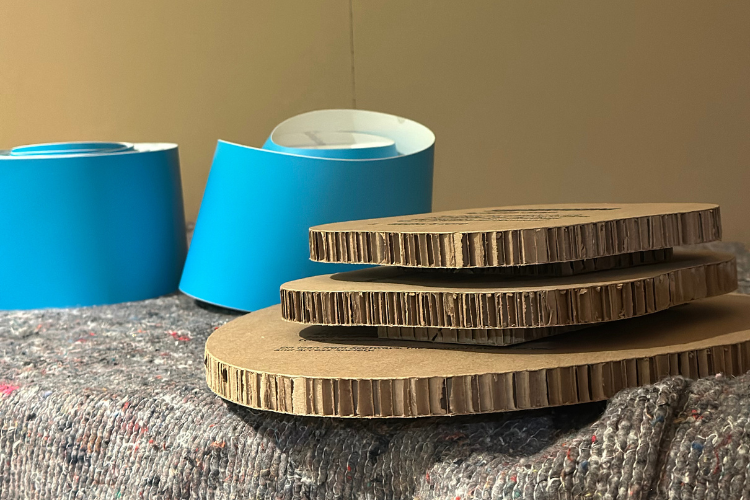
We were aiming for roughly 80% of anything new we created for the exhibition to be either recycled or reused for a specific purpose. We don’t know if we’ve achieved it; we’ll find out when the exhibition closes and we get to that stage. But we think we’re close.
Even if we’re not close, we’ve certainly made progress. All those labels and text panels you see in exhibitions are usually made of some form of plywood or plastic. With Xanita we’ll simply peel off the thin printed layer and recycle the rest.
The material is also a lot less carbon intensive to make. It’s extremely difficult to accurately calculate the carbon reduction, but we estimate that we’ve saved roughly 75% of the amount of carbon we’d have used for a similar exhibition compared with more traditional materials.
And the material is standing up. We wondered if the Xanita would quickly wear out during our busiest period of the year, but it’s still looking great.

Lyndsey Bowditch, director of Studioarc said: “It’s exciting to collaborate with clients who are genuinely committed to making a difference and bold enough to challenge the norm. Rewrite the Future gave us the opportunity to push our thinking. We wanted the design to embody the very ideas the exhibition explores: innovation, responsibility and reimagining the familiar. Cardboard delivered more than we hoped – not just as a sustainable material, but as a catalyst for curiosity and conversation.”
We’re already making plans to use the material again in next summer’s exhibition about the childhood wars of Mary Queen of Scots. It won’t be as obviously cardboardy; it’ll blend in, be less in-your-face, you might not even notice. But it’ll be there.
So thanks to a fantastic team combining University Collections and Museums with designers Studioarc and Eastern Exhibition and Display, who created the build, we’ve made some progress towards more sustainable exhibitions. There’s more that can be done, but a significant reduction in both waste and carbon is a decent start.
Rewrite the Future is open at the Wardlaw Museum until Sunday 28 September 2025.
Matthew Sheard
Head of Experience and Engagement
Discover more from University Collections blog
Subscribe to get the latest posts sent to your email.