
While at times – especially in the depths of December – the small City of St Andrews can feel very far from the centre of the universe, academic exploration in this corner of Fife has long contributed to our knowledge of the skies. Alumni lauded for expanding the horizons of their contemporary world into the night sky beyond include James Gregory (d. 1675), who worked to realise the reflecting telescope; George Forbes, who in 1880 already predicted the possibility of Pluto – confirmed only in 1930; and Irwin Finlay Freundlich, who set up the modern Department of Astronomy at St Andrews in the 1940s.
The carol for today, “All jubilant with Psalm and Hymn” (F.W. Farrar, ca. 1850s), show a similar interest in the astronomical theme. Here, verses underscore the contrast between the earthly “little planet star” and heavenly “azure floors” in the nativity tale:
“Then backwards sprang the golden doors
On that resplendent morn,
And Jesus left Heaven’s azure floors
To be the virgin born.
And while our little planet-star
Through its blue ether rolls,
Those angel notes shall blend afar
with songs of ransomed souls
Peace, Peace, on earth they sang,
and swelled the strain again;
And all the stary welkin rang,
“Goodwill, goodwill to men”.
(Extract, taken from “The poets’ Christmas”, W.T. Stead, p. 32)

When looking at the universe, where better to start than the astonishing Nuremberg Chronicle? Published in 1493, this history of the Christian world by Hartmann Schedel runs to over 600 pages with more than 1800 illustration, a significant undertaking and expense for Nuremberg merchants Sebald Schreyer (1446-1520) and Sebastian Kammermeister (1446-1503). With impressive confidence, the work provides readers with a picture of the start of the world.
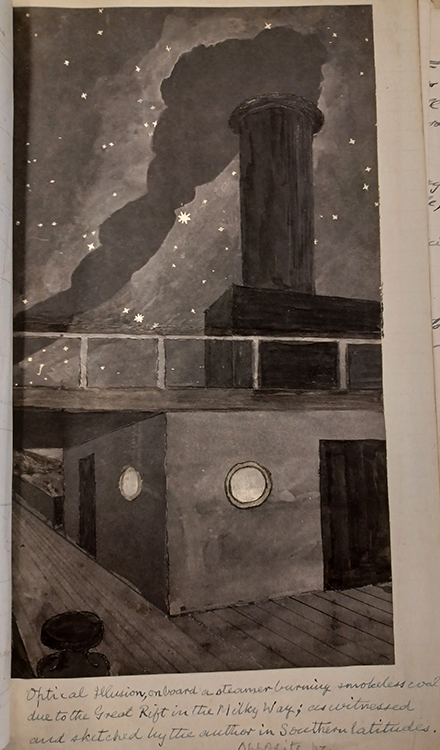
No less romantic, but more scientific in approach is this painting of the night sky by 19th-century astronomer George Forbes, in this case (apparently) observed first hand: “Optical illusion on board a steamer burning smokeless coal due to the great rift in the milky way; as witnessed and sketched by the author in the southern latitudes.”
Discover more from University Collections blog
Subscribe to get the latest posts sent to your email.