
The tale unfolding in verse today, centred upon Adam disobedience in plucking an apple from the tree, is preserved in just one manuscript. Happily, that manuscript is our old friend ms Sloane, and Wright has duly transcribed and published it in his seminal edition.
The anonymous medieval song writer appears to have been the ultimate glass-half-full sort of person, characterising Adam’s biblical error as a happy accident, necessitating the Virgin Mary’s role as mother of Jesus, and her subsequent ascent to Queen of Heaven:
“Adam lay ibowndyn · bowndyn in a bond
fowr’ þowsand wynter þowt he not to long (1)
And al was for an appil · An appil þat he tok
As clerkis fyndyn wretyn · in her’ book (2)
Ne hadde þe appil take ben þe appil taken ben
ne hadde neuer our lady · a ben heuene qwen (3)
Blyssid be þe tyme þat appil take was
þerfor’ we mown syngyn · deo gracias (4)”
(Found in “Songs and carols from a manuscript”, Thomas Wright, pp. 32 – 33; transcription by Dr Kathleen Rose Palti, “‘Synge we now alle and sum’: Three Fifteenth-Century Collections of Communal Song A study of British Library, Sloane MS 2593; Bodleian Library, MS Eng. poet. e.1; and St John’s College, Cambridge, MS S.54” (Thesis submitted for the degree of Ph.D., University College London Volume II: Appendices)

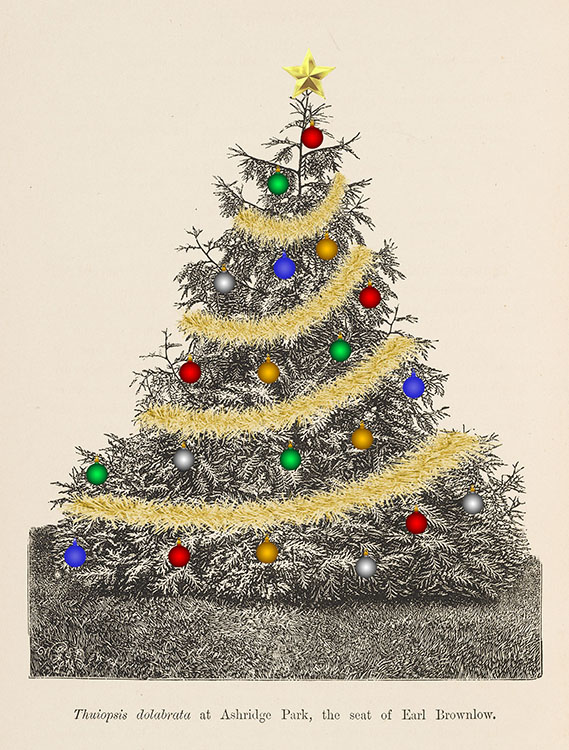
In more recent times, the tree most associated with winter festivities is not the apple tree, but the fir. In wreathes, swags and as Christmas Trees, this festive foliage brightens the season. Our wander through the winter woodland comes courtesy of the rather splendid plates in James Veitch’s “A manual of the Coniferae” (1881, s QK494.5C75V4). Veitch’s dry-sounding ‘manual’, provides striking portraits of conifers across Britain. Here, each tree is captured with botanical name, location and height: a snapshot in time of winters past.
Discover more from University Collections blog
Subscribe to get the latest posts sent to your email.
The narrative lyrics and the intricate illustrations are so fetching. Thank you!