
In this blog, conservator Molly Brass explains some of the behind the scenes work that went on in preparation of the new exhibition ‘War, Destruction and Reform’, now on at the Wardlaw Museum.
Recently, I helped conservator Erica Kotze prepare artefacts for the Wardlaw Museum’s exhibition, War, Destruction and Reform: The Early Years of Mary Queen of Scots.
One task was to prepare the following archives for display in picture frames behind acrylic glazing:
- A warrant authorising the absence of the Burgh of Dundee from the military host (1550), on paper, loaned from Dundee City Archive.
- A resignation of land burned by the English (1544), on parchment, loaned from the Edinburgh City Archive.
Framed artefacts are protected from physical impact and contact, but they can still be damaged by air pollutants or fluctuations in humidity unless they are sealed off from the surrounding environment.
Adhesive copper tape and Marvelseal® were chosen to encase the artefacts in sealed packages prior to framing. The copper tape gives rigidity to the assembly. Marvelseal® is a flexible laminate of aluminium foil, sandwiched between layers of nylon and polyethylene. When sealed with heat to the copper tape, Marvelseal® becomes a barrier to pollutants and moisture.
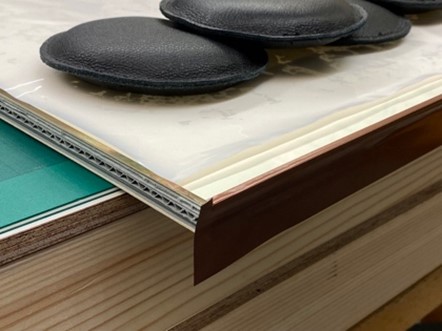
Before sealing the artefacts, we prepared a mockup to be tested for airtightness by submerging it under water. The mockup replicated the stacked layers of a framed work: glazing, window mount, mock paper artefact, support board layers and a backing mat board.
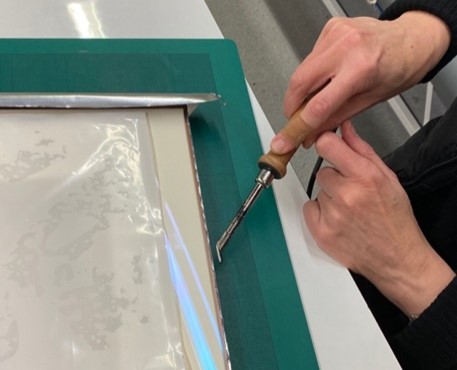
First, copper adhesive tape was applied to wrap around the edges of the stack and extend just a few millimeters onto the front surface of the glazing. Then Marvelseal® was wrapped across the back, over the edges and onto the front lip of copper tape. The Marvelseal® was sealed to the copper tape using a heat spatula. As the frame overlapped the glazing by 6 mm, precise positioning of the copper tape and Marvelseal was required to ensure these materials didn’t extend visibly beyond the inside edge of the frame.



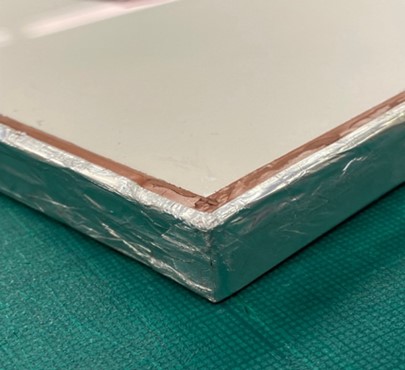
When this sealed package was placed into a large tray of water containing food colouring, it floated, needing weights to submerge it; a good sign. We saw no evidence of water getting past the seal, such as air bubbles, or any colour leaching behind the glass. We kept the frame submerged for several hours and felt assured.

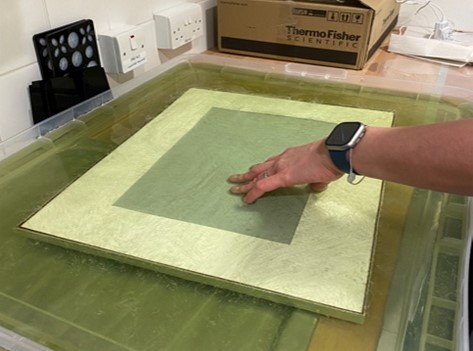

Our sealing method had passed the test and we felt confident in proceeding to prepare sealed packages of the artefacts to be displayed. These documents can be seen amongst many other interesting artefacts at the Wardlaw Museum until September 2026.
Molly Brass
Conservator
Discover more from University Collections blog
Subscribe to get the latest posts sent to your email.
Thank you! This fascinating! Just a question: the package layers had a mat board as the back of the package. Didn’t the mat board get wet when the package was submerged?
Hello Mary,
Great question!
The package layers included: a window and back mount with three spacer layers of archival corrugated board between them. The acrylic glazing was placed on top of the board layers, and the aluminium foil laminate (Marvelseal®) behind the layers, so that the various layers of boards are inside the Marvel seal before it is heat sealed to the copper tape on the glazing.
The board layers are encapsulated, or enclosed, within the sealed package thereby protecting the boards and any original item included from external changes in humidity, dust and airborne pollutants.