
In this blog, Dr Ian Lawson, Senior Lecturer in the School of Geography and Sustainable Development, shares how his and his colleagues’ research into sustainability shaped the proposal for ‘Rewrite the Future’, the current exhibition at the Wardlaw Museum.
Why do we need to think about sustainability? Just ask the Vikings. My journey into sustainability research began a couple of decades ago when I worked on a project looking at a grand ‘natural experiment’. Between 1000 and 1200 years ago, Viking-age Norse colonizers sailed west from Norway across the North Atlantic, looking for new lands to settle. By imposing a similar culture and way of life on environments ranging from the windswept Faroe Islands to the icebound fjords of Greenland, they unwittingly set up a wonderful controlled experiment in long-term sustainability.
Our interdisciplinary team of archaeologists, historians, and geographers unpicked the ways in which decisions taken by the Norse settlers played out over centuries. The outcomes varied hugely. In the Faroes, the Norse established a mixed fishing and farming economy that proved resilient right up to the modern era.

In Iceland, fragile forests and crumbly volcanic soils proved vulnerable to Viking-age land management techniques; 90% of the woodland cover was lost, and perhaps 40% of the soil was picked up by the wind and blown out to sea, leaving vast tracts of barren desert.

In Greenland, the colony collapsed; around 1485 CE it disappears from the historical records, leaving nothing but ruins in the landscape for later Danish settlers to wonder over. We’re still trying to determine whether the final blow was due to climate change at the beginning of the Little Ice Age, the bottom falling out of the European market for walrus ivory, conflict with Inuit groups, or a combination of all three.
One lesson I took from this story, at an impressionable point in my career, is that sustainability can’t be taken for granted. Civilizations come and go through the archaeological record. Some persist for millennia, but most eventually go through periods, cycles, or terminal episodes of collapse – by which we mean that they lose complexity, wealth, and stability. If sustainability couldn’t be taken for granted in the Viking Age, then how much more careful do we need to be today?

The North Atlantic colonies were little worlds to themselves in many ways, but in the highly-connected world of the 21st century, resource use, habitat loss and climate change threaten the viability of the whole planet as a home for human beings.
But this story also showed me that sustainability is not just about the environment. Culture matters too. Climate change might have made life difficult for Norse cattle farmers in Greenland, but the Thule Inuit – with a very different set of expectations about how to live well in the Arctic, and technologies to match – came off much better. One of my own papers pointed out that the success of the Faroese Norse might have been to do with the obvious fragility of that treeless archipelago, which meant they handled it more carefully from the outset than did their relatives in Iceland, where thick birch forest cover belied the ecosystem’s surprising sensitivity to disturbance.
Twenty years later, and with a lot more research experience in different parts of the world under my belt, I find myself co-directing a new initiative at St Andrews, the Centre for Critical Sustainabilities (StACCS for short). The Rewrite the Future exhibition at the Wardlaw Museum has been one of the first projects for StACCS. It’s our attempt to showcase some of the surprising ways in which questions of sustainability are being tackled by researchers at our university. In fact, over the past 18 months as I’ve taken advantage of my new licence to make connections across the institution, I’ve been struck by just how many of my colleagues are driven by their concerns about sustainability. That often means environmental sustainability – the biodiversity or climate crises perhaps – but sustainability means much more than that.

There’s a common understanding that when we talk about sustainable futures, we need to be careful to imagine a future for everyone, not just particular segments of society. My colleagues in the School of English understand that the stories we tell about migration can be divisive, and that (for example) enabling refugees to tell their own story goes some way to healing those divisions. Colleagues in Classics know that ancient understandings of disability resonate powerfully with the ways in which we still often exclude people with disabilities from full participation in society today – hence compromising the future of those individuals. Colleagues in Anthropology and in Geography and Sustainable Development work with communities in the UK and around the world that are poor and marginalized – living lives that are literally hard to sustain.
Many of my colleagues are busy developing new technologies that aim to address sustainability in very practical ways: for example, work based in Chemistry around replacing fossil fuel feedstocks for plastics, or in Biology to develop greener ways to farm seafood. While technological innovation holds a lot of hope for creating a greener, less carbon-intensive economy, other colleagues are focusing on the social and cultural implications of new technologies to ensure that they don’t cause more problems than they solve. In the School of Computer Science, researchers are asking how technologies like the internet or artificial intelligence can be made to serve different cultures and communities around the world, rather than forcing everyone to think like a computer. Over in the Botanic Gardens, people are challenging our expectations of what it means to be at home, wondering if we can learn to live with new building materials – algal walls – that invite nature into our living spaces rather than keeping it at bay.


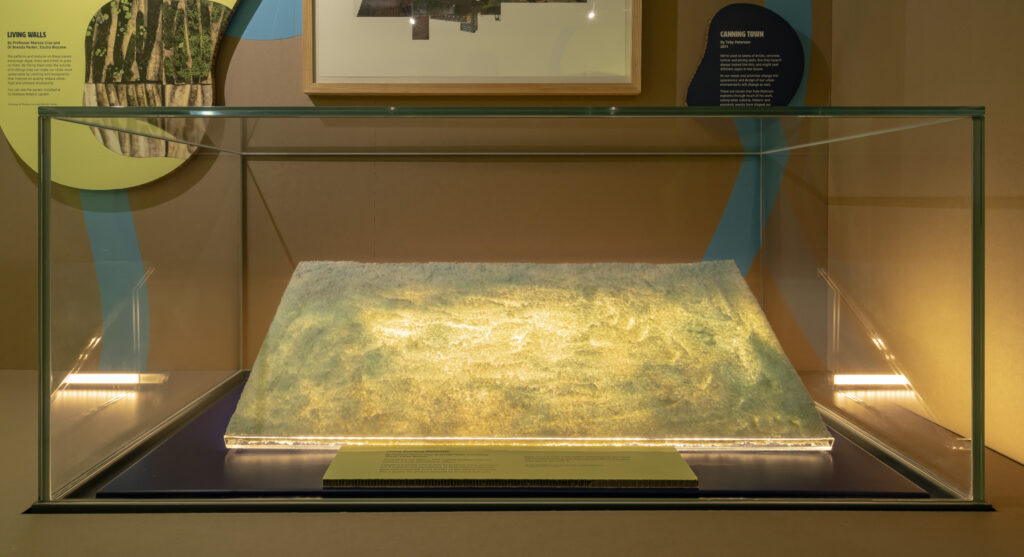

Sometimes it might feel as though we don’t have much control over the shape of the future; that the best we can hope for is something a bit cleaner and greener than the past. But as these examples show, people everywhere are imagining different possibilities for the future. Many of us at St Andrews see our research as being about feeding new ideas into the mix, creating opportunities and alternatives. If we have options, then the next question is: how do we choose between them? And who should do the choosing? This exhibition, and the events programme that the Museums team has developed around it, aims to showcase a small selection of ideas and help us all to think about what it really means to build a sustainable society.
Dr Ian Lawson
Senior Lecturer, School of Geography and Sustainable Development
Discover more from University Collections blog
Subscribe to get the latest posts sent to your email.