

The St Andrews student newspaper “College Echoes” from December 1925 provides what is simply described as a “traditional carol”:
“Carol, carol, merrily,
Christ is born for us today
Christ is come on earth to stay.
Fulfilled is the prophecy
Carol, carol merrily.
Carol forth your joy.” (1)
“See the shepherds with their crooks
Fold their sheep in sheltered nooks;
Hasten with expectant looks,
Carolling with joy.” (4)
The article provides no other context for the carol. However, the inclusion of a carol indicates that by 1925, at least, carol afficionado Englishman William Hone’s bleak assertion that “in Scotland, where no church feasts have been kept since the days of John Knox, the custom (of carolling) is unknown” no longer rang true (Hone, “Ancient Mysteries Described” p. 103).
Certainly, when James C. Irvine – later to become Principal – first arrived in St Andrews in 1895, he was glad to discover St Andrew’s reputation as a “singing university” well-justified. A student Musical Society had banded together by 1886, with a specific “Christmas Concert” first recorded in 1889 –though this does not exclude informal concerts prior to this date. It may have been at just such a concert that the carol appeared.

In addition to verses with familiar images from the Gospel narrative Christmas, this carol, reaches for imagery of the natural world less typical of the carols we sing today:
“See the garden cherry tree
Burst its bonds for very glee
Scattering fragrance full and free
Blossoms of its joy” (5)
“See the quivering aspen tree
Tree of death and life to be
Never burden such as He
Therefore, carol joy”(6)
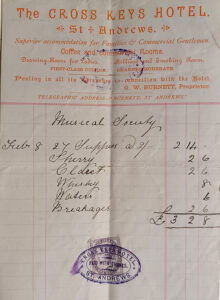
The Society’s concerts do appear to have been a jolly affair. Receipts indicate that the concert halls were indeed “decked” with foliage and wreaths – in a rather environmentally conscious twist, hired from the local greengrocer. A hearty helping of stocks from the local vintner including sherry, claret and whisky can’t have hurt the festivities, though may not have improved the singing.
Reference:
William Hone, “Ancient mysteries described, especially the English Miracle plays, founded on apocryphal New Testament story, extant among the unpublished manuscripts in the British Museum: including notices of ecclesiastical shows, the festivals of fools and asses-The English boy-bishop The descent into hell-The Lord Mayor’s Show The Guildhall Giants- Christmas Carols; etc” (1823; s PR643.M5H7)
Discover more from University Collections blog
Subscribe to get the latest posts sent to your email.