
This medieval song takes us into a flourishing springtime garden, to hear the Christmas story. Our narrator leads us through lush greenery to a scene of trees filled with singing doves. Here we meet a dazzling woman, who reveals to her tale.
As with some of our previous entries, the text is bursting with greenery and birds. But, in this case it is the ‘turtil’ (dove), a more familiar festive friend from carols such as “The twelve days of Christmas”:
As I went throw a gardyn grene,
I fond an erber maykyd newe;
A fayrere syte had I non sene,
On every tre song a turtil trewe (1)
Therin a womman bryzt of hewe,
Che syde in here song not lest,
This was here carpyng, as I knew,
Verbum caro factum est. (2)
In than wonne forzt gan I wynde
A semely song that herd I tho,
Of thre schepperdes that wern ful hynde,
Gloria in excelsis Deo. (5)
(From Wright, “Songs and Carols from a manuscript”)
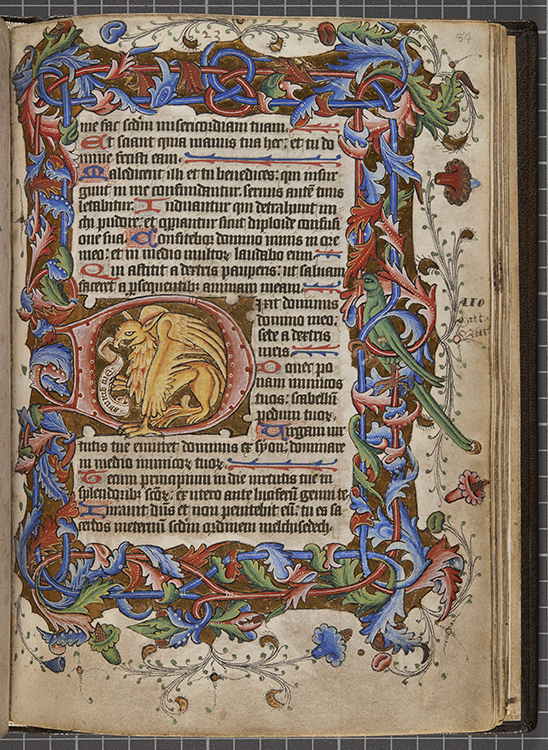
Several of our medieval psalters continue stay true to this garden theme, featuring pages festooned with elegant vines and beautiful flowers. This example is from a fifteenth century book of psalms which was probably of English origin. Many pages are lavishly decorated with flowers, men, birds, monkeys, dragon, griffins and other creatures.
Reference:
J.P. Selby, “The natural history of pigeons : illustrated by thirty-two plates, coloured, and numerous woodcuts” (1835, s QL4.N2)
Thomas Wright, “Songs and carols from a manuscript in the British Museum of the Fifteenth Century.” (1856; s PR1105.W2)
Discover more from University Collections blog
Subscribe to get the latest posts sent to your email.