We’ve all heard of “The Holly and the Ivy”, but what about “The Ivy and the Holly”? Pay closer attention to the version of this popular carol we hear most often, and you will begin to notice a theme – it’s all holly and no ivy!
The carol presented by W.T. Stead in his “The Poet’s Christmas” (1890), appears to give us a hint of the backstory of an age-old battle between holly and ivy for time in our carols and our halls…
Nay, ivy, nay
it shall not be I wis
Let holly have the mastery
As his manner is. (1)
Holly stand in the hall
Fair to behold
Ivy stand without the door,
She is full sore and cold. (2)
Ivy has berries
As black as any sloe;
Then come the owl
and eat him as she go (6)
Holly has birdies
A full fair flock
The nightingale, the popinjay,
the gentle laverock* (7)
Good ivy,
What birdies hast thou?
None but the howlets
That cry “how how”. (8)
*Lark


Border from the presentation address received from Regia Universita degli Studi, Rome, UYUY185/500/7/1/120
These ornate vines are taken from the borders of two celebratory addresses, sent to mark the 500th anniversary of the university in 1911, the first from Royal College of Physicians, Edinburgh, and the second from the warmer climes of the Regia Universita degli Studi, Rome.
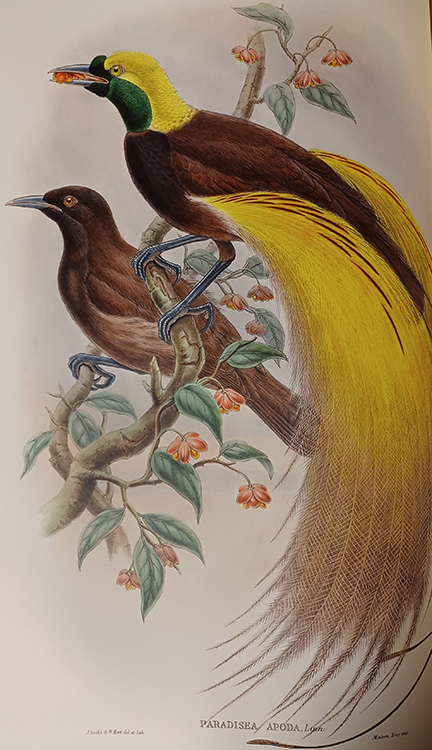
Observant viewers will note that our “birds eating berries” are not, in fact, owls, nightingales, or larks – but could they be howlets? Given that this carol gives poor ivy a rather cold write-up, I suspect a ‘howlet’ is not intended to be such a stunning bird, but who can resist the colours of these paradise birds, illustrated by William Hart (Richard Bowdler Sharpe, “Monograph of the Paradiseidae”, vol 1, rff QL696.P2S4).
Discover more from University Collections blog
Subscribe to get the latest posts sent to your email.