
Reving up at the starting line of the whacky-carol races is this bawdy drinking song, titled simply “Old Norman Carol”.
Included in the collection by W.T. Stead, the editor does not give us any further context for where he has discovered this gem, nor regarding the translator “Dr. Douce”. The attribution seems to refer to English antiquarian, and collector of manuscripts (including medieval manuscripts of French carols), Francis Douce (1757 – 1834). In this case, it seems Douce took the text of the carol from a thirteenth-century manuscript known as British Library, ms. reg. 16, E. viii, sadly missing since the late 19th century.
A right-rollicking ditty of hospitality, merriment and (slight) excess, this carol open with an ethical exhortation to care for the stranger, yet finishes with somewhat of a “how-to” guide to the fully stocked seasonal cellar:
| “Old Norman Carol” (trans Dr. Douce) | |
| Now Lordlings listen to our ditty, | (Seignors ore entendez a nus, |
| Strangers coming from afar; | De loinz sumes venuz a vous, |
| Let poor minstrels move your pity, | Pur quere Noel; |
| Give us welcome, sooth our care. | Car leur nus dit cet hostal, |
| In this mansion, as they tell us, | Soleit tenir sa fest anuel. |
| Christmas wassail keeps to-day, | Alu c’est iur. |
| And as king of all good fellows, | Deu doint a tuz icels joire d’amurs, |
| Reigns with uncontrolled sway. (1) | Qui a danz Noel derunt honours”(1) |
| (chorus) Hail, Father Christmas! Hail to thee! | |
| Honoured ever shalt thou be! | |
| Endless pleasures wait on those, | |
| And all the sweets that love bestows, | |
| Who like vassals brave and true, | |
| Give to Christmas honour due. | |
| Lordlings, Christmas loves good drinking, | |
| Wine of Gascoigne, France, Anjou; | |
| English ale that loves not thinking, | |
| Prince of liquors old or new. | |
| Ev’ry neighbour shares the bowl, | |
| Drinks the spicy liquor deep | |
| Drinks his fill without control, | |
| Til he drowns his care in sleep. (5) |
(Extract of “Old Norman” and translation by Dr Douce taken from “The poets’ Christmas”, W.T. Stead, pp. 29 – 30)

College members and visitors to the University of St Andrews through its earliest history would almost certainly have been provided with beer. The college diet books and receipts show that beer and ale were ordered with regularity; that the colleges had their own “malt barns”; and that local tradespeople held an annual contract to supply the colleges with beer.
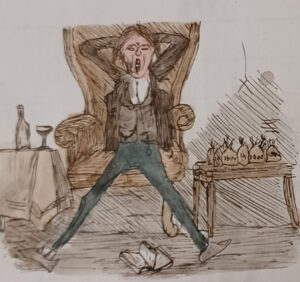
It is with slight embarrassment that I must admit that it was also quite easy to find images of individuals worse for wear within the archival collection. Here are a couple of cartoons from two amateur humourists: one by Jack Williams, brother-in-law of Principal Irvine and Professor of History at the University, and a slouching drinker imagined by Walter Hubbard.

Alcohol also had a practical role as a good way to preserve a glut and provide for the lean seasons. So, our historic recipe books offer plenty of options for boozy fruit: the Edwards family records recipes for Currant Wine (ms38783); Mrs King (msdep137/7) has a useful wine for unripe grapes and Mrs Greig jots down “Mr Anderson’s green gooseberry wine” (ms37011).
Mrs Greig, however, also includes suggestions for one or two more unusual tipples, such as the exotic-sounding “Noyau”. This name, apparently, is derived from the seasonally-appropriate Old French ‘Noel’ – though a false friend, as in this case the word’s meaning was, among others, stone or pit. This French spirit would typically be made from brandy, but Janet Greig’s recipe, in a local twist, calls for a pint of whisky to be steeped with bitter almonds and sugar. The page here leads onto another drink, the rather fearsome sounding “Major John’s Milk Punch”. Requiring a gallon and pint of rum, two nutmegs, cinnamon, sugar and 12 lemons and three quarts of milk, any imbiber may indeed be left drowning his cares in sleep!
References:
Information on translator Francis Douce: Douce, Francis, 1757–1834 – Medieval Manuscripts
Information on the carol and translation of all verses: Season’s greetings from the Medieval French Reading Group! > Exeter Medieval Studies Blog
The mysterious disappearance of ms reg. 16 E viii: A clue to the fate of the lost MS. Royal 16 E VIII, copy of theVoyage de Charlemagne – Persée
Discover more from University Collections blog
Subscribe to get the latest posts sent to your email.
Jack Williams was of course Irvine’s brother-in-law, and taught History at St Andrews.