
The twelfth-night tradition of wassailing, either awakening orchard trees with singing and cider or roving groups of wassail-singers visiting homes, is a custom associated with the south-west of England. Yet in recent years it has been revived and adopted more widely, with Fife wassailing held in Cupar, Kirkcaldy and Tayport.
This wassailing song, recorded by Sandys, records a broader remit of blessing; beyond apple trees, it wishes for fruitfulness and plenty in all domestic spheres for those visited by the wassailers, from the dairy to the hive:
“The wassail”
Give way, give way ye gates and win
and easie blessing to your bin
and basket, by our entring in. (1)
Next may your dairies prosper so,
As that your pans no ebbe may know;
But if they do the more to flow (3)
Then may your plants be pressed with fruit
Nor bee or hive you have be mute.
But sweetly sounding like a lute. (5)
(taken from “Christmas carols, ancient and modern”, William Sandys, pp. 44 – 45)
While the City of St Andrews may have no ancient tradition of wassailing, the history of beekeeping is written across its historic walls. Look closely, and bee boles – small stone nooks – can be seen. These sheltered openings which provided a skep (traditional beehive) with protection from the sea wind, were documented by St Andrews archaeologist Edwina Proudfoot, whose extensive collection of slides remain within the university archives.

Historically, honey and beeswax had a plethora of uses, from preserving food to uses in treating ailments, as we can see from the full-page print on beekeeping included in Pomet’s complete history of drugs. One very important provision, in this town of churchmen, writers and scholars, was the use of beeswax for seals, which were affixed to records to display the identity of participants, assure of authenticity and communicate authority. Here are two examples from a 1483 charter:

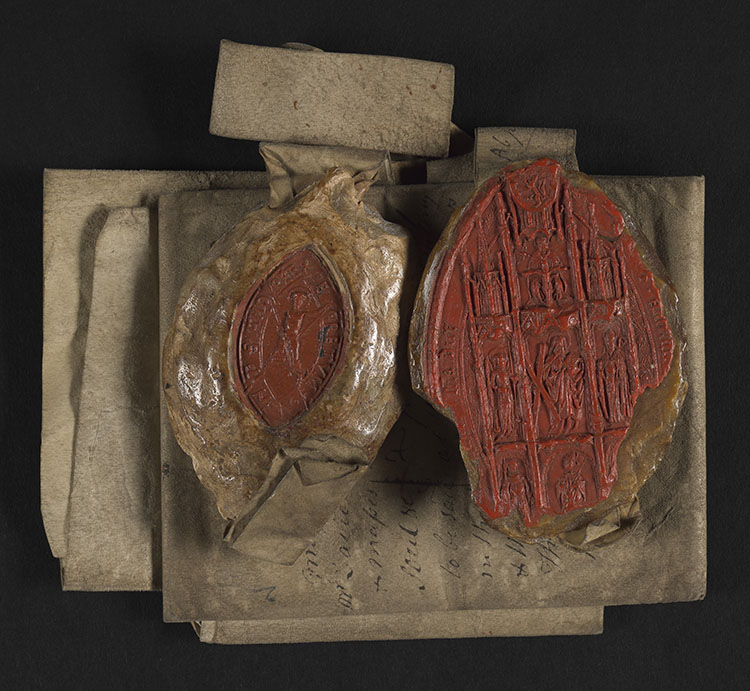
The second impression, in red wax, is the seal of Archbishop William Scheves, showing an altar-piece style design with shield at top and seven compartments, featuring the Holy Trinity with seated figure of the Father beneath architectural canopy holding cross with crucified Christ, with dove of the Holy Spirit by the Father’s right shoulder; a row of standing saints including St Michael(?) figure, holding tall cross, with halo, wings and weighing scales; St Andrew with cross; Standing Bishop with mitre and crozier; in addition, it shows a female figure which may be St Margaret(?); a standing Bishop(?) with crozier and mitre, with two finger impressions visible on reverse (ms39179/Lee 2).
It may have been that, when all boles were in use, the City of St Andrews did indeed “sound sweetly like a lute” with the hum of bees.
Discover more from University Collections blog
Subscribe to get the latest posts sent to your email.